

1. Experiment Background
Currently, in the egg-laying chicken breeding process, as the breed is improved and the laying cycle is extended (target at 100 weeks of age), the metabolic pressure of the egg-laying chickens reaches its limit. 25-hydroxyVitamin D3, as the active metabolite of vitamin D3, is becoming a key nutrient to solve the core pain points in egg-laying chicken breeding. 25-hydroxyVitamin D3 bypasses liver metabolism and is less affected by liver and intestinal damage, significantly enhancing calcium and phosphorus absorption, strengthening bone structure, preventing egg-laying fatigue syndrome in egg-laying chickens, reducing paralyzed chickens and death losses, improving eggshell quality, and reducing the proportion of cracked eggs, cracked eggs, and dark spot eggs.
D-NOVO® is a 25-hydroxyVitamin D3 product independently developed by Key Ingredients Biotechnology (Yichang) Co., Ltd. using biotechnological synthesis technology. It has the characteristics of high absorption efficiency (all active ingredients are fully water-soluble), good stability, good mixing uniformity, and is environmentally friendly and green.
2. Experiment Objective
To evaluate the effects of using D-NOVO (25-hydroxyVitamin D3) on the production performance and eggshell quality of laying hens in the later stage of egg production.
3. Materials and Methods
➢ Experimental site: A large-scale egg chicken farm in Xunwu County, Jiangxi Province (with 1 million chickens)
➢ Experimental period: 35 days, from October 21, 2024 to November 25, 2024
➢ Experimental animals: Two buildings of 460-day-old Hy-line Grey egg chickens, 52,500 chickens per building, totaling 105,000 chickens
➢ Experimental treatments:
a) The experimental group’s basal diet was supplemented with D-NOVO at 0.05% (125g/ton),
b) The control group was fed the basal diet.
➢ Measurement indicators: After 15 days of feeding, the egg production rate and mortality rate were continuously collected for 20 days. The eggshell strength, eggshell thickness were measured, and the proportions of dark spot eggs and cracked eggs were statistically analyzed for comparison.
Test Results and Discussion
1. Egg production rate:
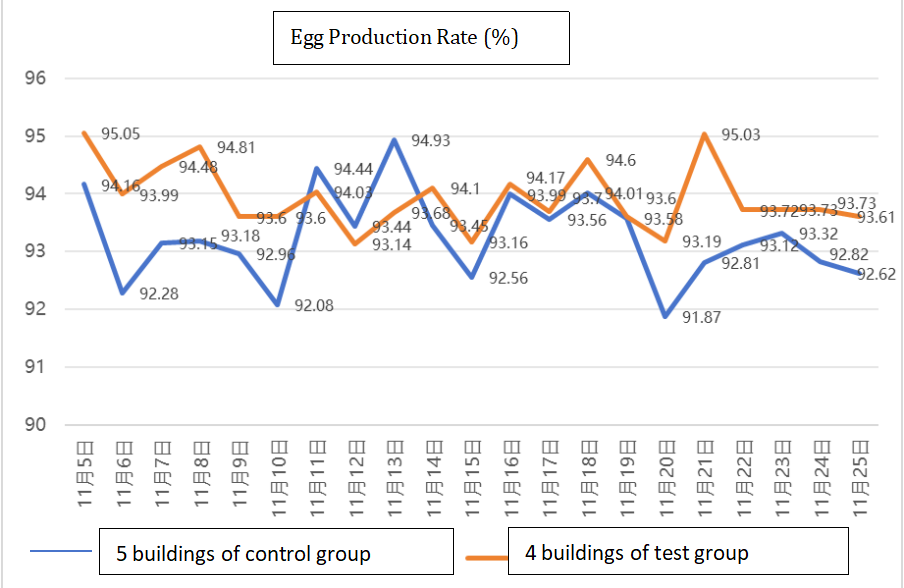
The egg production rate of the experimental group was generally stable. In contrast, the egg production rate of the control group fluctuated significantly. This indicates that the use of 0.05% D-NOVO can alleviate the decline in egg production rate during the later stage of laying, and compared with the control group, the average egg production rate increased by 0.68% (see Figure 1).
2. Mortality and abortion rate
As shown in Figure 2, the mortality and abortion rate of the experimental group decreased significantly after 4 weeks of using D-NOVO. The average mortality and abortion rate dropped from 4.38 to 3.28, indicating that D-NOVO can enhance the immunity of laying hens in the later stage and reduce the number of dead and aborted chicks.
Add a Comment